Business Signage and the Safety Signs the Law Requires
Safety signs are the one part of your business signage that the law has an opinion about. Nearly every guide you’ll find on them was written for another country, and they tell you there are four categories of sign. In South Africa there are five, and the standard that sets them is not the one those articles cite. If your signage was specced off a British checklist, it’s worth a second look.
What are the five types of safety signs in South Africa?
South Africa uses five categories of symbolic safety sign: prohibition, warning, mandatory, safe condition and fire equipment. They’re set out in SANS 1186, the South African national standard for symbolic safety signs, and they sit alongside the duties the Occupational Health and Safety Act 85 of 1993 places on every employer.
Here’s the thing. Most of the search results you’ll land on give four categories, not five. Those pages are written in the United Kingdom or the United States and they describe British or American rules. South Africa splits fire equipment into its own category, which the four-category systems fold in elsewhere. Get that wrong and you can end up with a board that looks compliant and isn’t.
- Prohibition signs stop an action. No smoking, no entry, no naked flames.
- Warning signs flag a hazard that’s present. Electrical hazard, slippery surface, forklifts operating.
- Mandatory signs require an action, usually protective equipment. Eye protection must be worn, hearing protection must be worn.
- Safe condition signs point to safety. Emergency exits, escape routes, first aid points, assembly areas.
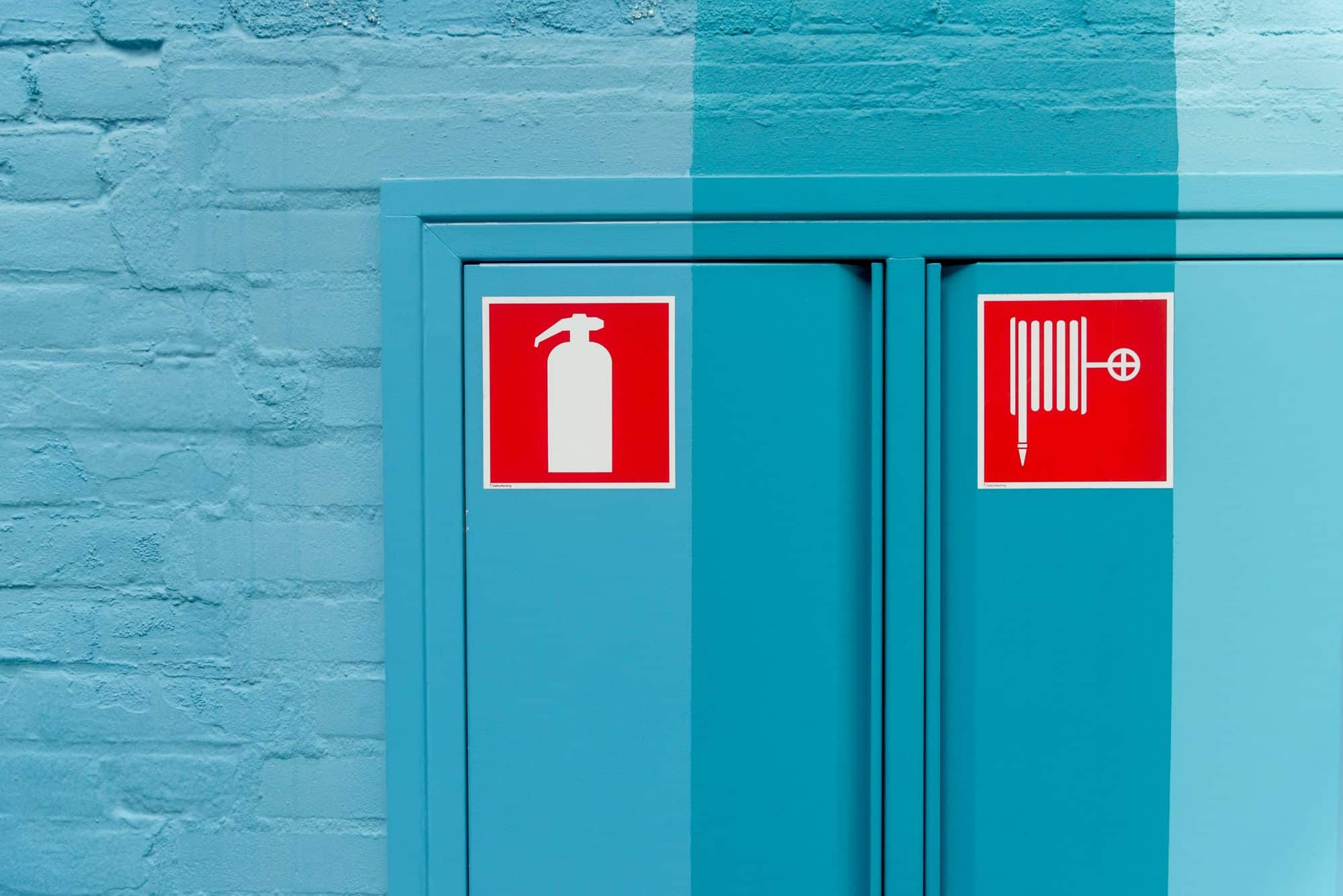
- Fire equipment signs mark where the firefighting kit is. Extinguishers, hose reels, alarm call points.
The same standard travels. Botswana adopted it as BOS 6, Eswatini as SZNS 044-1 and Mozambique as NM 67, so a compliant South African sign set generally reads correctly across the region too. That matters if you run branches over the border.
This is a different thing from the marketing taxonomy of identification, directional, informational and regulatory signage, which is how signs get grouped commercially rather than legally. We cover that split on our business signage page.
How many safety signs does a workplace legally need?
South Africa doesn’t fix a universal number of safety signs. You’ll see “the 9 mandatory safety signs” quoted all over the internet, and that list comes from a British source, not South African law. The set you need comes out of your own hazard identification and risk assessment under the Occupational Health and Safety Act, so a quiet accounting office and a metal fabrication shop land on very different lists.
That’s an honest answer rather than a tidy one. It’s also the answer that keeps an inspector happy, because the test is whether your signage matches your actual hazards.
In practice most South African workplaces end up displaying at least these:
- Fire extinguisher and hose reel location signs, wherever equipment is mounted
- Emergency exit and escape route signs, including the route to the assembly point
- First aid station location
- No smoking, in the areas where smoking is prohibited
- Eye and hearing protection, where the risk assessment calls for it
- Electrical hazard signs on distribution boards and switch rooms
Add to that anything specific to your site. A workshop with an overhead crane needs signage a showroom never will. A chemical store needs warnings a warehouse of dry goods doesn’t. Walk the floor with your risk assessment in hand and mark the gaps. It takes an hour and it’s the only reliable method.
Once you know the list, you can get a quote for a full safety sign set printed to the right sizes for your site.
What do the shapes and colours actually mean?
Shape and colour carry the meaning before anyone reads a word, which is the entire point of a symbolic sign. SANS 1186 fixes the geometric shape, the colour and the pictorial symbol for each category so that a worker who speaks none of your site’s languages still understands the message at a glance.
The pattern runs like this:
- Prohibition: round, red ring, red diagonal bar, black symbol on white
- Warning: yellow triangle, black border, black symbol
- Mandatory: solid blue circle, white symbol
- Safe condition: green square or rectangle, white symbol
- Fire equipment: square or rectangular, white background, red border, red pictogram
Red means stop or fire. Yellow means be careful. Blue means you must. Green means this way to safety.
Where this goes wrong is colour drift on the printed sign. A green that’s drifted towards teal, or a fire red that’s printed closer to orange, breaks the recognition the whole system depends on. Colour accuracy on safety signage isn’t a cosmetic concern, it’s the function.
Symbol size matters too. The standard sets minimum symbol heights because a sign has to be readable from the distance people will actually be standing. A 110 mm symbol that works in a corridor is useless across a warehouse floor.
Not sure your signage matches your risk assessment?
Send us your list or your floor plan and we’ll quote the full set, printed to the correct colours and sizes.
Get my safety signage quote
Where each sign has to go
A safety sign only works where it can be seen, so placement is a compliance question and not a decorating one. Signs must be clearly visible, unobstructed, securely fixed, legible and properly illuminated, and they have to be inspected and maintained routinely rather than hung once and forgotten.
Four placement rules cover most sites:
- At the hazard, not near it. A warning sign three metres from the thing it warns about warns nobody.
- At eye level and unobstructed. Stock, pallets, notice boards and seasonal displays are the usual culprits. Walk the route quarterly.
- At decision points. Escape route signs belong at every junction where someone has to choose a direction, not only at the exit door.
- Lit, or able to be seen when the lights fail. Emergency exit signage that vanishes in a power cut has failed the one moment it existed for.
Load shedding makes that last point sharper in South Africa than almost anywhere. If your escape route signage depends entirely on mains lighting, you have a gap. Photoluminescent signage is the usual answer and the standard covers it.
Maintenance is the part everyone skips. Sun fades pigment, especially reds, and a faded prohibition sign reads as decoration. Put signage on the same inspection schedule as your extinguishers and you’ll catch it early.
Printing safety signage that lasts
Outdoor and industrial safety signs need a substrate matched to where they’ll hang, because the sign only stays compliant while it stays legible. Chromadek, ACM and Correx each suit different jobs, and picking wrong is how a sign set ages badly inside a year.
We won’t repeat the full comparison here. There’s a detailed breakdown of which sign board material to use on our signage page, including where each one belongs.
Two things worth knowing when you order safety signage specifically. First, the symbols and colours have to follow the standard, so this isn’t a job for improvised artwork. Second, order the full set together. Sites that buy signs piecemeal end up with mismatched sizes and three different greens, which undermines the recognition the system relies on.
We print safety signage alongside the rest of a company’s branded material, so a signage order can run with your corporate print rather than as a separate exercise. Send us the list and we’ll come back with a quote within 24 hours.
Frequently asked questions
Do safety signs have to be SABS approved?
Safety signs should comply with SANS 1186, the standard published by the South African Bureau of Standards. The SABS publishes and sells the standard, and the SAICE bookstore lists the current edition as SANS 1186-1:2015, Symbolic safety signs Part 1. What matters in practice is that the sign follows the specified shape, colour and symbol for its category.
Who is responsible for safety signage in a workplace?
The employer is. Section 8 of the Occupational Health and Safety Act 85 of 1993 puts a general duty on the employer to provide and maintain a working environment that’s safe and without risk to health, and signage falls inside that duty. Delegating the printing doesn’t delegate the responsibility.
Can I use safety signs in English only?
Symbolic signs are designed to work without text, which is exactly why the system is built on shape, colour and pictogram. Text can be added below the symbol, and many South African sites do add it. The symbol must still carry the message on its own.
Get your workplace signage checked and quoted
One list, one supplier, correct colours and sizes throughout. We’ll come back to you within 24 hours.
Price my safety signs